Contents:
1. Introduction
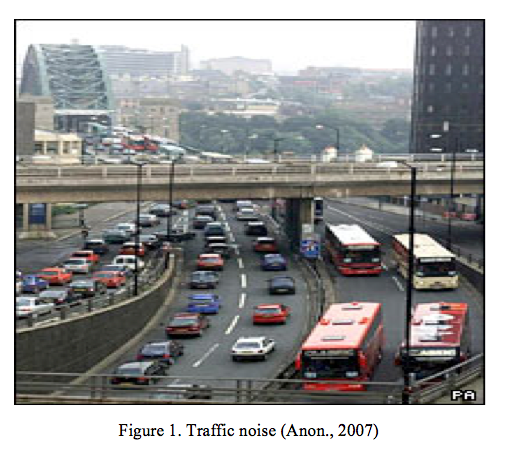
Nowadays, one of the most serious threats to the environment is noise pollution. The traffic noise is not only a threat to the environment but, also to mankind. After many researches it has been found that in the United Kingdom 18% of people are extremely or very annoyed by traffic noise (Anon., 2003). Traffic noise has economic, health and environmental costs.
The purposes of this project is to assess the relationship between traffic derived noise and speed of travel and also to look at measures of reducing the impact of noise on the surrounding environment. To achieve this, appropriate surveys from the local road network were used. Noise monitors and speed radar guns were also used to measure the generated noise and relate these measurements to speeds. Finally, critical reviews will be conducted on statistical data conclusions (M.Scholz et al, 2011).
2. Background
The analysis of noise pollution is based on the principles of sound. Based on this, an investigation on sound waves is undertaken for further analysis.
2.1 Sound
General speaking the definition of sound is a mechanical wave transmitted through the air and is easily heard by any person with normal hearing (Moorhouse, 2009).
More specifically the sound is created from the forth and back movement of the particles through the air and some materials, such a water and steel.
As a result of the movement of the particles involve, compressive or longitudinal waves are created.
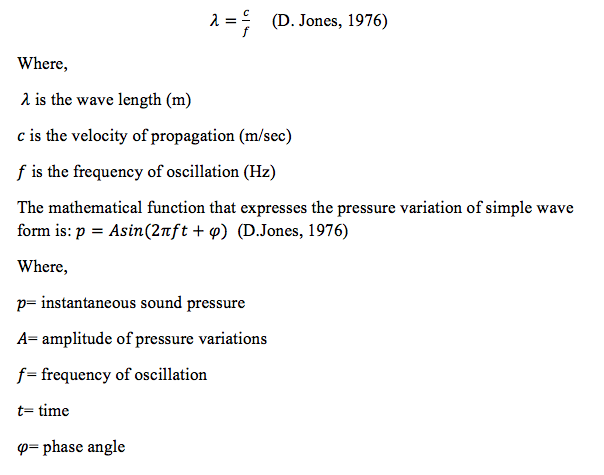
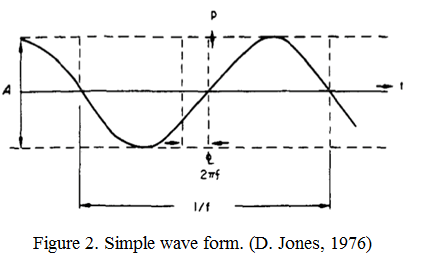
Attributes of the longitudinal waves describe the sound. The sound waves are described by the following relationship:
3. Noise pollution
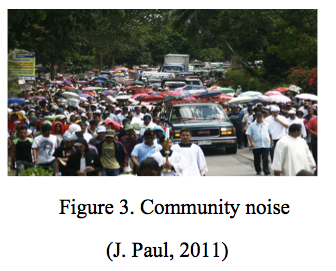
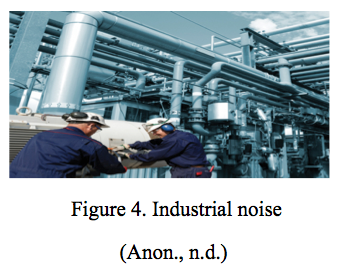
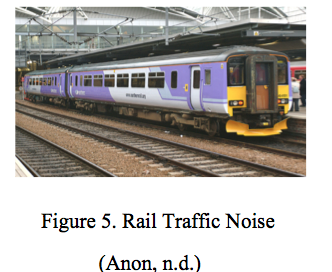
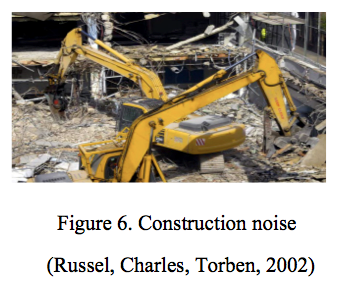
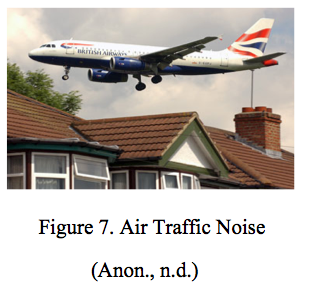
Nowadays one of the largest problems in the world is noise pollution. The main categories of noise pollution are:
ØCommunity Noise
ØIndustrual Noise
Ø Construction Noise
Ø Rail Traffic Noise
Ø Air Traffic Noise
Ø Traffic Noise
 |  |
 |  |
 |  |
3.1 Traffic Noise
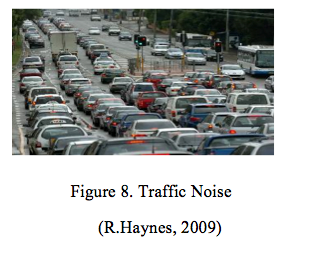
Noise is the sensation of pressure fluctuations in the air to the receptor. Noise is often defined as unwanted sound. Road traffic noise is the noise produced from individual vehicles in the traffic stream.
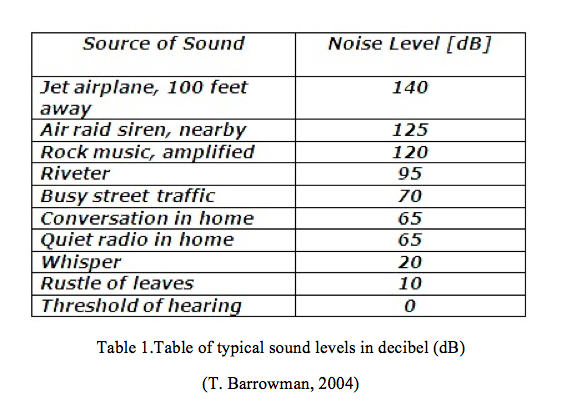
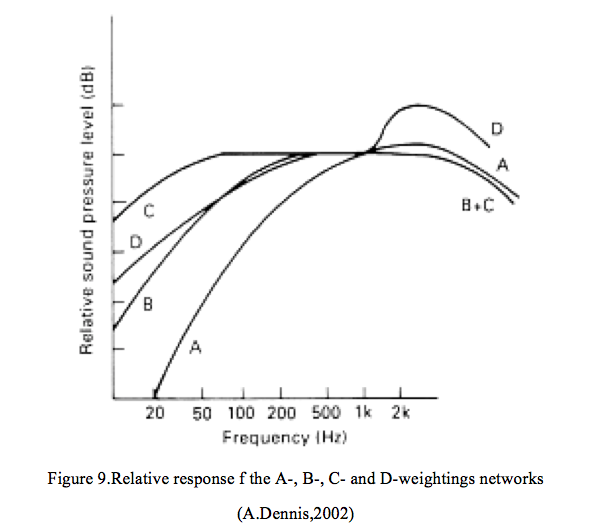
Noise is measured by the decibel scale (dB), which is a logarithmic scale. The decibel unit is a ratio which describes the sound pressure and is divided in four weighting networks:
· A-Weighting network: human response for low sound level.
· B-Weighting network: human response for medium sound level.
· C-Weighting network: human response for high sound level.
· D-Weighting network: human response from noise around airport.
The range of the decibel scale is between 0 to140dB. Nowadays the “A” and “C” weighting networks are the most commonly used.
3.2 Factors that affect traffic noise
Many factors cause traffic noise. The principal factors are:
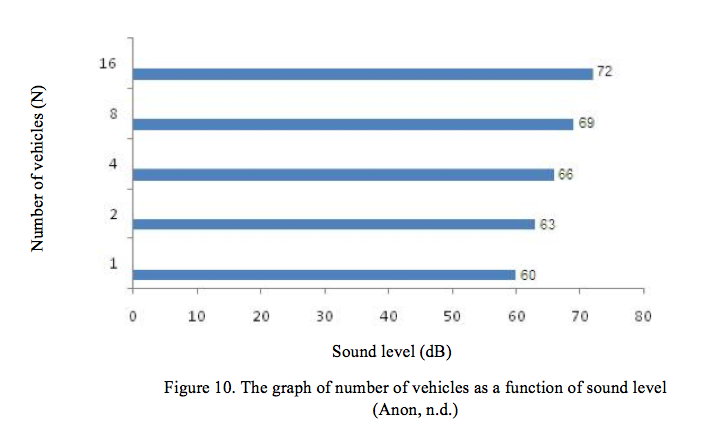
Ø Traffic volume (average daily traffic)
Ø Average traffic speed of vehicles
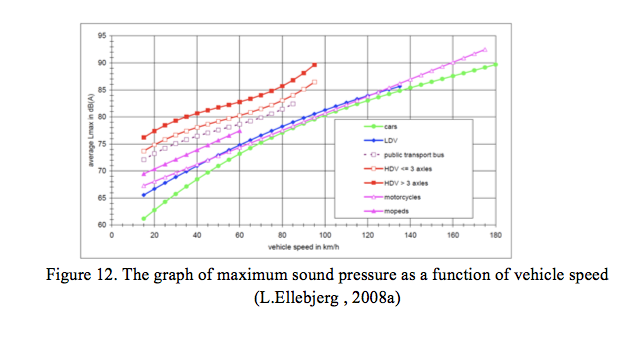
Ø Type of vehicle (heavy vehicle, light vehicle and etc)
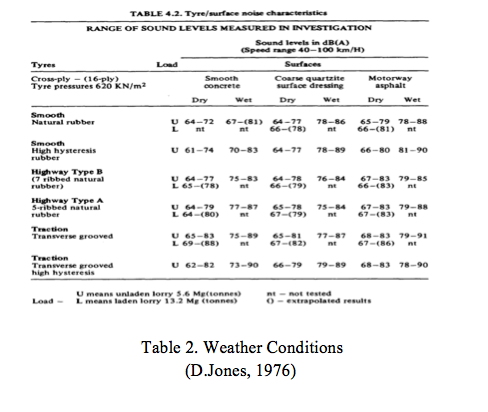
Ø Weather conditions
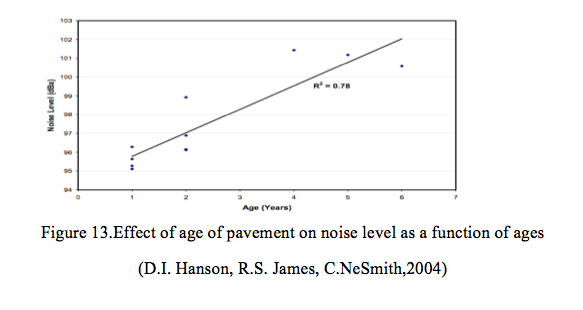
Ø Road pavement surface type (quality of road, age, materials, etc)
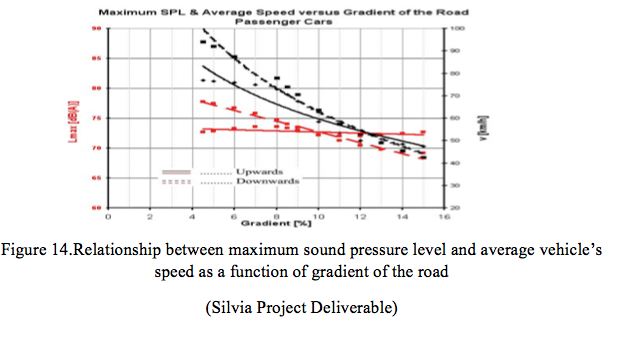
Ø Road gradient (longitudinal slope of the road)
3.3 Traffic noise affects the following issues:
Ø Environment
Ø Health
Ø Economy
Environment: After researches, very high environmental noise levels due to traffic of vehicles were observed. Traffic noise influences the air quality of the surrounding areas, causing pollution.
Health: Traffic noise disrupts hearing, learning and understanding impacts, which are particularly significant for child development. Also after research related to traffic noise, it was found that it also causes stress and sleep disturbance.
Economy: Studies in the European Union shows that last year about 40 billion euro spent for finding a solution which minimise the impact of traffic noise and improve the lives of many people, all over the world (Mitchell, P. 2009).
3.4 Recommendations to minimise the phenomenon ‘traffic noise’
i. For the highway design
Ø Restrictions on heavy vehicle for night time
Ø Speed limit reduction
Ø Improve the design of the roads- highway
Ø Round-top/ circle-top road humps
Ø Roundabouts
Ø Shrubs on the side of roads
(Mitchell, P. 2009)
ii. For the buildings
Ø Insulation
Ø Double glazing
Ø Double wall
Ø Materials with sound insulation value
4. How to measure traffic noise
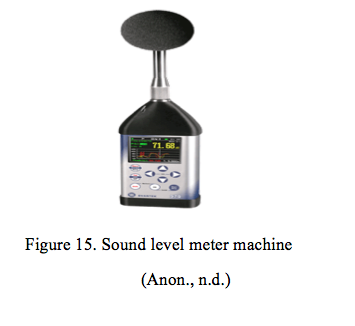
The measuring method for traffic noise is the same as that of noise and is measured by using sound–level meters. The change in sound pressure (SPL) is used to detect and record the traffic noise.
Ø There are many different types of sound – level meters. In our dissertation we will use the "Svan957" machine, (shown in figure 13) :
The video below shows how noise is measured:
4.1 Outer Noise Measurement
When we investigate the A-weighting scale categories the following categories are defined.
There are three categories of outdoor microphone locations which are defined below:
· Free-field
This category implies that the distance from any sound reflecting on the microphone is at least twice the distance from the dominating part of the sound source to the microphone.
Exceptions to this are small sound reflecting surfaces, since the reflection has insignificant effect (<0.5dB)
· + 6 dB
The microphone is located on a plane and surface of concrete, tile or other material, where the measurement reaches a noise level equal to the level of the receiving sound plus 6 dB.
The minimum distance from the microphone to the surface edge should be no less than 1m.
· + 3 dB
The allowed distance "d" at which the microphone is positioned in front of the facing wall (given in Table 3). The equivalent or maximum noise level recorded is less than 1 dB from the level of incoming sound plus 3 dB.
Table 3: Instruction to distances from the microphone used for the category +3dB
|
|
LAeq from source seen under more than 600 |
LAFmax or LAeq from source seen under more than 600 or less |
|
d (m) |
0.5 |
1.0 |
|
a (m) |
≥5 |
≥20 |
|
b (m) |
≥2 |
≥4 |
|
c (m) |
≥1 |
≥2 |
a: distance from the microphone to the road.
b: microphone projection on the facing wall to the nearest horizontal edge.
c: microphone projection on the facing wall to the nearest vertical edge.
d : distance in front of wall.
4.2 Indoor Noise Measurement
The distance between the microphone to the walls, ceiling or floor shall be set at least 0.5m and 1m from the microphone to the sound transmission elements, e.g windows or any other air intake openings.
In the case where more than one microphone are used, the distance between neighbouring microphone positions shall be at least 0.7m.
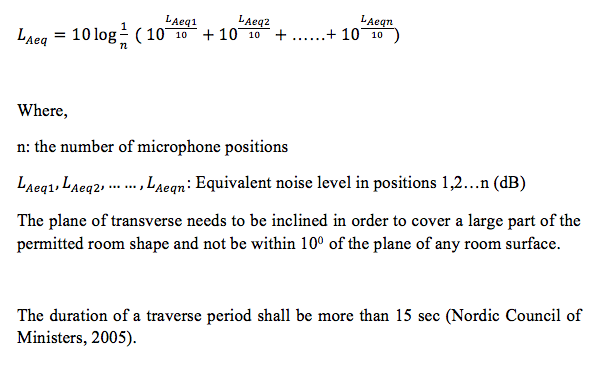
The average equivalent level from the room is calculated using the following equation:
4.3 General usage instruction
The measurement that is taken from the sound level meter machine can be divided to the following statistical analysis:
LAeq,T : Continue sound pressure in dB(A) at over period of time T.
LAmax,T : Is the maximum sound pressure level in dB(A) over an interval of time T.
LAmin,T :Is the minimum sound pressure level in dB(A) over an interval of time T.
LA90, T: This is the noise level in dB (A), which during the sampling interval T, was exceeded for 90% of the time. As with LAeq,T, the interval should be defined (Moorhouse, 2009).
All the above concepts for measuring in traffic noise are based on the international standard "ISO 1996" which refer to Acoustic – Description and measurement of environmental noise.
4.4 Noise Measurement Report must include:
Ø The time and date of the measurement with the names of the person which make the survey.
Ø The type of the sound level meter.
Ø The microphone used and calibrator.
Ø The statement of the noise measurements of the site.
Ø A map that shows the position of the site which is measured.
Ø A map with the meteorological conditions.
Ø A map with the background noise level of the area that will be observed.
Ø Description of the site which the observations will take place.
(Safety& Environmental Knowledge Base, 2009)
5. The role of the civil engineers for monitoring the traffic noise:
The department of "Transport Engineering" is responsible for the measurements of speed and noise survey and try to analyse the level of impact from traffic noise in each noise pollutant area. The first issue of the site observed is the determination of traffic noise parameters using statistical data. Using statistical parameters; such as the probability distribution, the mean and the variance of sound pressure levels are calculated. Once, this objective is achieved, the limits of meaningful predictions of the average sound pressure level are taken from the simple model with fixed source locations. Finally, the statistical data taken will be used to estimate valuable parameters for the human response to traffic noise pollution (U.J Kurze, 1971).
6. How the speeds affect traffic noise
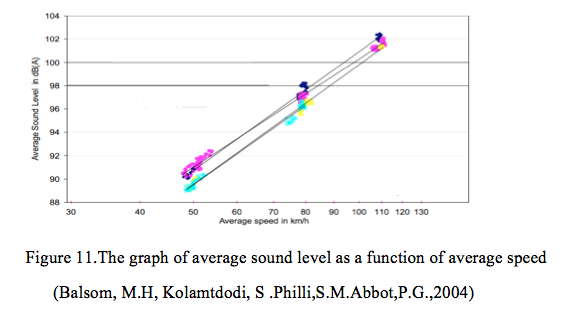
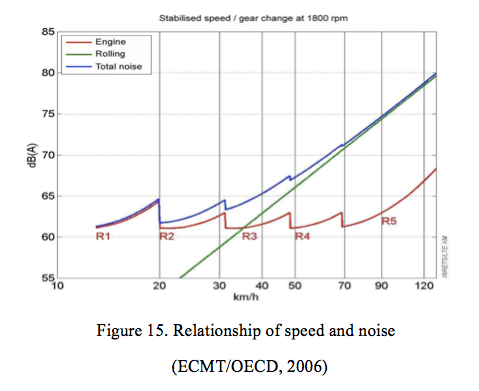
On a general note, speed is the most important factor which causes traffic noise. It is clear the relationship between speed and noise can affect the level of traffic noise. The traffic noise due to the speed is created by:
Ø The tyre, which is interacting with the road
Ø From the engine acceleration
Ø The brakes
Ø The transitions
Ø The exhaust system
For the measurement of speed, a speed gun will be used.There are many kinds of speed detector such as laser speed detection system and radar system. In this project, the radar system is chosen which is is presented on the video below. This machine works using a combined transmitter and receiver. It sends ratio waves on the moving object and then the transmitted waves are reflected back.These waves are recorded either in kilometres per hours (km/h) or in miles per hours(MPH) and the results are shown up on the screen of the radar (R.J.Stephenson and G.H. Vulkan, 1967).
The graph below shows the relationship between speed (Km/h) and noise dB(A):
The video below shows how speed is measured:
